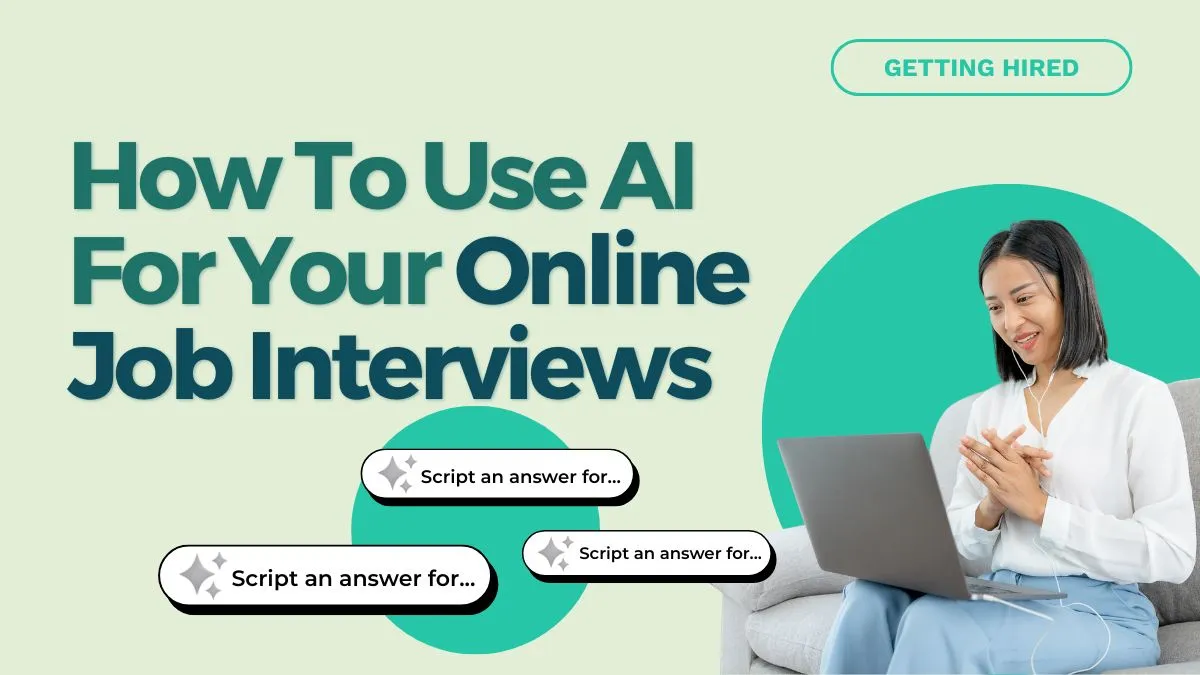
Is it okay to use AI during an online job interview?
Think of it this way: AI is a useful tool, not a shortcut. It can help you find the right words, but it’ll never replace the years of hard work you’ve put into your career. You’ve earned your qualifications.
AI is just there to help you sharpen your edge while your genuine experience leads the conversation.
If you’re getting ready for an online job fair, you need to know how to navigate the tech without losing your human spark, or looking sus in front of your interviewer.
hese fairs move fast, and recruiters are getting sharper at spotting “robot-mode” candidates who are reading from a script rather than speaking from the heart.
The goal is to use the technology to handle the heavy lifting of preparation so that when the camera turns on, you can focus entirely on connecting with the person on the other side of the screen.
Here are three ways to use AI as your secret interview weapon.
Build a story bank with the STAR method
Recruiters love behavioral questions (“Tell me about a time when…”).
You can paste your resume into an AI tool and say: “Based on my experience, help me draft three STAR stories (Situation, Task, Action, Result) that show how I handle classroom conflict.”
This will help you organize your thoughts and stay on point while answering questions.
The mission statement deep dive
Want to impress a specific school?
Paste their “About Us” page or mission statement into the chat and ask: “What are the top three values this school looks for in a teacher, and how can I highlight my experience in differentiated instruction to match them?”
This way you’re able to match your school’s vibe and prove that you’re a fit.
Live practice with instant feedback
Instead of just reading questions, use voice mode on your phone.
✨Prompt: “Act as a principal hiring for a Grade 4 position. Ask me one challenging question at a time and give me feedback on whether my tone sounds encouraging and professional.”
Practicing out loud turns your stories into procedural memory, so when the pressure is on, your brain knows the ‘path’ to the answer without you having to overthink it.
What about using AI tools during the interview?
Having notes in front of you is one thing. But if you’re considering actively using AI tools during a live chat, here’s a gentle reality check.
You might think you’re being subtle, but recruiters, or anyone really, will notice when a conversation feels ‘off.’
These are just a few tell-tale signs that a candidate is relying too much on a screen and not enough on their brain.
- The “Scanning” Stare: When we think, our eyes naturally wander as we recall memories. If your eyes are moving rhythmically from left to right, it looks exactly like you’re reading a teleprompter or a ChatGPT window.
- The Latency Lag: There’s a specific kind of silence that happens when someone is waiting for a tool to generate an answer. If you consistently pause for 3-5 seconds of “dead air” before every answer, even for simple questions, recruiters start to wonder if you’re waiting for a script to load.
- The “Wikipedia” Voice: AI answers are often perfectly structured (e.g., “First, I would… Second, I believe… In conclusion…”). While being organized is good, humans usually speak with a bit more “messiness.” If you sound too manicured and lack those natural “ums” or “ahhs” we all have, it can feel robotic and stilted.
- The Echo Tactic: A common “cheat” is repeating the interviewer’s question back to them slowly to buy time for the AI to type out an answer. Doing this once is fine; doing it for every question is a major red flag.
Use the STAR method
The goal of an interview isn’t just to give the “correct” answer; it’s to show the school who you’ll be when you’re standing in front of thirty kids on a Tuesday morning. AI can’t replicate your passion for your subject or the way your face lights up when you talk about a student’s “aha!” moment.
Use AI tools to get organized and confident, then close the extra tabs, look into the camera, and just be yourself. You’ve got the skills. Use your tech to make sure you’re front and center.
That’s a great way to start. The STAR method, Situation, Task, Action, and Result, is the gold standard for interviews because it keeps your stories concise and evidence-based.
Here are some specific prompts you can copy and paste into an AI tool like Gemini or ChatGPT to help you build out your story bank for the job fair.
Prompts for classroom management
Classroom management is usually the first thing recruiters want to know about. You can use this prompt to find your best examples:
✨”I’m a [Insert Grade/Subject] teacher. Based on my resume [paste your resume text below], help me identify two specific situations from my past where I successfully managed a difficult classroom dynamic.
Structure these using the STAR method, focusing specifically on the ‘Action’ steps I took to turn the situation around.”
Prompts for student achievement
When you need to prove you can actually move the needle on student learning, try this:
✨”I want to highlight my ability to use data to improve student outcomes. Can you help me draft a STAR response based on a time I noticed a student or group was struggling and adapted my teaching style to help them succeed? Please emphasize the ‘Result’ part of the story with measurable outcomes.”
Prompts for parents and community
Schools at job fairs are looking for “culture fits.” They want to know how you’ll interact with the community. Use this:
✨”Act as a school recruiter. Ask me a behavioral question about how I handle a difficult conversation with a parent. Once I give my answer, tell me if I sounded empathetic and professional, and help me refine my ‘Action’ steps to sound more collaborative.”
How to use these prompts effectively
Once your chosen AI tool gives you a draft, don’t just memorize it! Make it yours. Here’s how:
- Swap the “AI-isms”: AI loves words like “testament,” “pivotal,” and “fostered.” If those aren’t words you’d normally say while grabbing a coffee with a colleague, swap them out for something more natural.
- Focus on the “I”: AI often writes in the collective “we.” Make sure you change the focus back to what you specifically did in that classroom.
- Keep it under two minutes: When you practice these stories out loud, aim for a two-minute delivery. It’s the sweet spot for keeping a recruiter’s attention on a video screen.
Keeping it ethical and authentic
At the end of the day, a school isn’t hiring an algorithm; they’re hiring someone to inspire their students.
What is totally fine
Using AI to research common questions, practicing your delivery, and getting help with your resume’s grammar are all great ways to use the tech. It shows you’re a professional who knows how to use modern tools to stay efficient.
What to avoid
Never let AI generate your answers in real-time during the interview. Not only is it a breach of trust, but it also prevents you from showing your true personality. If a recruiter asks a follow-up question that the AI didn’t prepare for, you’ll be left hanging.
Trust your experience. You’ve put in the work in the classroom, and that’s what recruiters really want to see. Use the tools to get organized, then close the extra tabs, look into the camera, and just be the great teacher you already are.
Your next big move is just a screen away.
Our next Online Job Fair kicks off on March 8th, 2026. Sign up today, polish those STAR stories, and get ready to shine in the “new” interview world. We’ll see you there!