If you’re an educator working outside the United States, you’ve probably realized that a U.S. teaching license is one of the most powerful tools you can have.
It isn’t just for teaching in America; it’s the gold standard for top-tier international schools in places like Dubai, Seoul, and London.
But if your degree isn’t from a U.S. university, you’ve likely run into a confusing wall of requirements.
You’ll hear terms like “NACES,” “Course-by-Course,” and “GPA Conversion.”
We’re going to demystify that.
What is a Transcript Evaluator?
A transcript evaluator is a specialized organization that reviews academic credentials earned outside of the United States to determine their U.S. equivalents.
For those seeking U.S. teacher certification, these organizations “translate” international degrees into a format that U.S. licensing boards and universities can understand.
Here are the key functions and requirements of these evaluators:
- Credential Verification: They verify that an international degree is equivalent to a U.S. bachelor’s degree.
- Course-by-Course Analysis: Evaluators provide a detailed report that lists every individual subject studied, rather than just a general degree summary.
- GPA Calculation: They convert international grades into the U.S. 4.0 Grade Point Average (GPA) scale.
- Professional Certification: To be accepted for teacher certification, the evaluator must be a member of a recognized national association, such as NACES (National Association of Credential Evaluation Services) or AICE (Association of International Credential Evaluators).
- Translation Services: Many evaluators, such as IEE, Scholaro, and SpanTran, also offer professional translation services if the original transcripts are not in English.
Evaluators typically offer two types of reports: provisional evaluations and official evaluations, which are required for the final teaching license application.
Step 1: Understanding the Transcript Evaluation
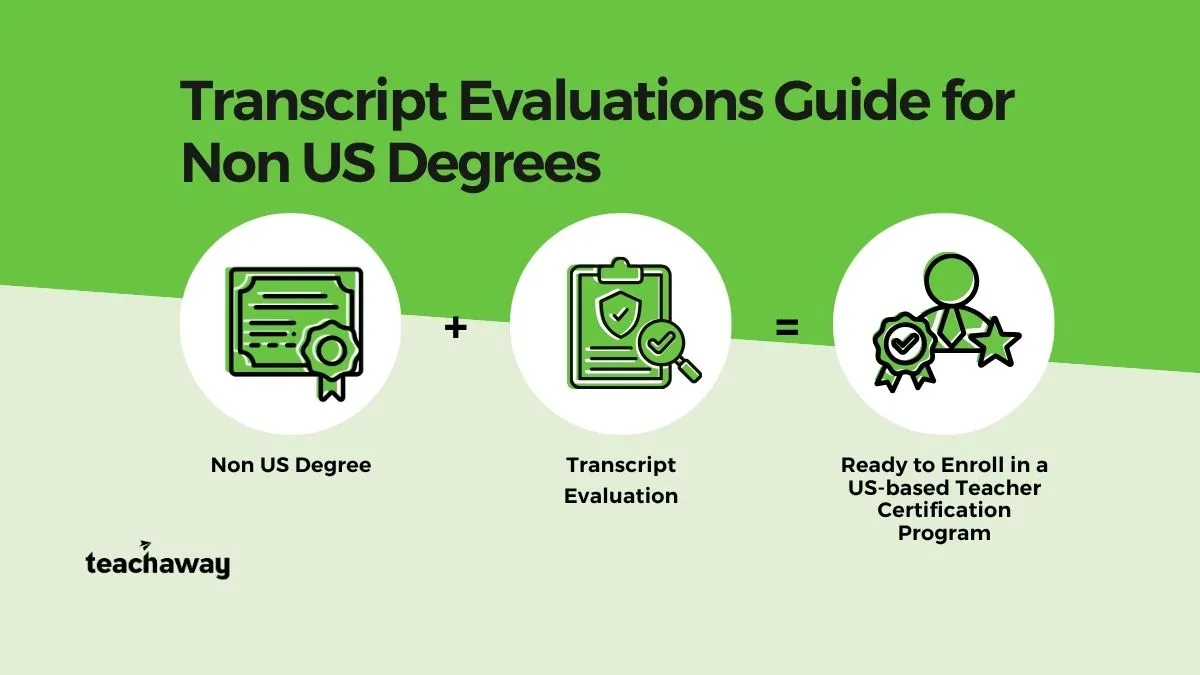
You can’t just send your original diploma to a U.S. state licensing board. They won’t accept it. Instead, you have to go through a process called a Transcript Evaluation.
Think of an evaluation agency as a “credential translator.” They don’t just translate the language; they translate the academic value.
They look at your years of study, the level of your courses, and your grades to determine if they match U.S. standards.
The Universal Requirements
Regardless of which state or program you choose, your evaluation must meet these three criteria:
- It must be Course-by-Course: A general evaluation that just says “this is a degree” won’t work. Your transcript evaluation must list every single subject you studied.
- It must include a GPA: U.S. programs typically require a 3.0 GPA for admission. The evaluator calculates this for you.
- It must be from an approved member: Usually, this means a member of NACES (National Association of Credential Evaluation Services) or AICE (Association of International Credential Evaluators).
Step 2: Gathering Documents Around the World
Getting your papers in order is usually the longest part of the process. It’s important to start this early.
Every country has its own way of handling “official” records, and university websites can be a maze.
When you’re searching your school’s site, look for terms like “Registrar,” “Academic Affairs,” “Student Records,” or “Alumni Services.“
East Asia
- China: You can’t just mail your transcripts yourself. You’ve got to start with CHESICC (China Higher Education Student Information and Career Center). They verify your degree internally before sending it to a U.S. agency. Most evaluators won’t accept documents directly from a Chinese university anymore.
- Japan and South Korea: These countries are very strict about “Official” status. You need your transcripts in a sealed envelope with a fresh registrar’s stamp across the seal. On your university website, look for the “Certificates for Graduates” section.
- Hong Kong: Most universities here have dedicated “Academic Registry” pages. Look for the “Transcript Application” section, most will allow you to pay a small fee to have them mail a sealed copy directly to your evaluator.
Southeast Asia
- Singapore: Many schools here use digital sharing like OpenCerts. This is a lifesaver. It’s fast, secure, and accepted by most major evaluators. Look for “Digital Credentials” on your school’s student portal.
- Thailand and Vietnam: If your school doesn’t have a digital portal, you’ll need to request “Certified True Copies.” Look for the “Registration Office” or “Office of Academic Affairs.”
The Middle East
- Attestation is Key: In many Gulf countries, your transcript isn’t considered “ready” until it’s been stamped by the Ministry of Education. Search your university site for “Attestation Services” or “Graduation Requirements” to see if they provide a direct link to the Ministry’s portal.
Europe and the Americas
- The Diploma Supplement: If you’re in the EU, look for the “Bologna Process” or “Diploma Supplement” page on your university website. This document is designed exactly for this purpose and often removes the need for extra descriptions of your courses.
- United Kingdom and Ireland: Look for the “Student Records” or “HEAR” (Higher Education Achievement Report) section. Many UK schools now use Digitary to send secure, official PDFs directly to evaluators.
- The Language Barrier: If your degree isn’t in English, you’ll need a translation. Agencies like IEE can do the translation and the evaluation at the same time for a flat fee.
Step 3: Choosing an Evaluator
You’ve got dozens of options, but they aren’t all equal. Prices and speeds vary wildly.
We recommend the following agencies because they have direct portals with many U.S. universities, including one of our school partners, Moreland University.
| Agency | Best For | The “Moreland Example” Price |
| IEE | People with multiple degrees (fixed rate) | $145 |
| WES | Anyone in a major hurry (7-day turnaround) | $163 |
| SpanTran | Those with a standard 4-year degree | $170 |
| ECE | Direct digital reporting | $190 |
| Scholaro | In-house verification | $209 |
| FIS | High-touch, personalized help | $245 |
Note: These prices are often discounted for Moreland applicants, but they represent the general range you can expect to pay for any NACES evaluation.
Step 4: The Application and Beyond
Once your evaluation is in the works, you can actually start your application. Most programs (Moreland included) will let you apply with a provisional evaluation or even unofficial transcripts while you wait for the final report. This is a huge time-saver.
The Testing Phase
Proving your education is just half the battle. You’ll also need to prove your skills.
- Basic Skills: Tests like the WEST-B or Praxis Core cover reading, writing, and math.
- Content Knowledge: If you want to be a Math teacher, you’ll take a Math test. If you want to teach Elementary, you’ll take an Elementary test.
- Pro Tip: You don’t have to fly to the U.S. to do this. Most of these tests can now be taken via online proctoring from your living room!
Universal Checklist for Aspiring Teachers
If you’re feeling overwhelmed, just follow this list. (It works for almost any U.S. certification path.)
- Request Transcripts: Get two sets from your university: one to keep, one to send.
- Select a NACES Evaluator: Use the table above to find a match for your budget.
- Submit for Evaluation: Use the “Course-by-Course with GPA” option.
- Choose a Prep Program: Look for programs like Moreland University that are designed for remote, global cohorts.
- Take Your Exams: Schedule your Praxis or WEST-B tests online.
How to Apply Your New Knowledge
Now that you know how the “behind-the-scenes” of transcript evaluations and U.S. certification works, you might be wondering where to actually start. While these steps apply to any U.S. license, we’ve found that the smoothest path for our community is through Moreland University.
Why Moreland is Teach Away’s Top Choice
At Teach Away, we’ve vetted countless programs, and Moreland consistently stands out as our top recommendation for international educators.
They’ve stripped away the “gatekeeping” you often find in traditional higher education.
Instead of requiring you to move to a campus in the U.S., they’ve built a 9-month program specifically for busy, working professionals living anywhere in the world.
We love them because they don’t just leave you to figure out the paperwork on your own. They’ve actually built dedicated portals with the evaluation agencies we mentioned earlier, which means your documents are less likely to get lost and your application moves faster.
It’s a global program that feels like a local experience.
Get Started With Moreland
If you’re ready to turn these steps into a career, here is how you can apply to Moreland through Teach Away today:
- Submit Your Basic Info: Head to our Moreland University page for more information, or apply now on Moreland. The application takes 10-15 minutes to complete.
- Start Your Evaluation: Use the links in this guide to begin your transcript review. Remember, you can often start your Moreland application while your official evaluation is still being processed!
- Join Your Cohort: Once accepted, you’ll join a small group of fellow educators from around the globe, starting your journey to a U.S. license together.
Earning a U.S. Teaching License When You A in the U.S. is a Commitment
It’s a bit of a paperwork marathon, but the finish line is worth it. You aren’t just getting a credential; you’re gaining professional “passport” that works in almost any country on earth.